

At Ossett Brewery, cask is driving impressive volume growth. And at Salt Beer Factory its Alpacalypse session IPA is flying. As managing director of both Ossett and its sister business Salt Beer Factory, Edd Simpson and his team are ably balancing a buoyant cask market and the desire of hop-forward pale ales and IPAs. And he’s enthused more than ever about the future.
“I recently met with a dozen large, independent UK cask producers. The temperature around the room was palpable. Everyone was seeing real positive growth. We are up 40% this year volume-wise, and the majority of that growth is driven by cask. What is being reported regarding a drop in cask beer sales is simply not what we are seeing on the ground.”
Edd Simpson is in a confident mood. While volumes across the larger macros might be down, he is seeing day-in, day-out, the strong performance of cask beer in the UK. And in his role, he knows all too well the importance of catering for audiences of both cask and keg beer.
Because in the contemporary British beer landscape, navigating the divide between traditional cask ale and modern craft keg is a challenge that few brewing groups manage seamlessly. Yet, as managing director of Ossett Brewery and Salt Beer Factory, Simpson oversees precisely this dynamic.

On one hand, he manages Ossett, a 28-year-old, deeply established regional brewer built on the heritage of British cask. On the other, he guides Salt Beer Factory, a fast-growing, progressive, keg-focused craft brewery. Balancing these two distinct identities requires a fresh perspective, something Simpson brings in abundance thanks to a career path that took him through the worlds of music, teaching, and fine wine before he ever stepped foot in a commercial brewhouse.
The world of wine to the beauty of beer
Simpson’s route into the beer trade was far from linear. Before entering the drinks sector, he spent a decade playing in bands including Once Upon a Dead Man alongside his brothers and also their friend Simon Britcliffe. However, a honeymoon trip to Croatia proved to be the turning point that redirected his career.
“Wine was a rich blessing in the sense I spent 10 years trying to be in a band but it getting to the point when I was 28 realising I needed to find another career and earn a living,” Simpson reflects.
He would meet his now-wife and Simpson had been working as a teacher for several years. The duo would wed and a honeymoon in Dubrovnik would open his eyes to a new calling.
“With wine, I didn’t know red from white really. We went to this little wine bar down a side street in Dubrovnik, and they did these little wine flights. A gentleman took me through three whites and three reds from the local Dalmatian wines from the island,” says Simpson.
“He’d show me the map and point out the influences on why the wine tasted that way,” he recalls. “I have absolutely no idea why, because I had no interest previous to that, but it just properly lit a fire, and I spent the rest of my honeymoon boring the sh*t out of my wife, talking about what other producers we could find.”
According to Simpson, his wife wouldn’t help the matter because when they arrived back home, she “made the mistake” of buying him tickets for ‘Three Wine Men’ with Oz Clarke, Olly Smith, and Tim Atkin. An event that really got him hooked.”
Hooked on the industry, Simpson joined Yorkshire Vintners, rising to associate director over four years before leaving to launch his own venture, Barrique Fine Wines.

It was through Barrique Fine Wines that Simpson’s path intersected with Yorkshire hospitality titan Jamie Lawson, the founder of Ossett Brewery and Salt Beer Factory. Simpson had already been supplying wine to Ossett’s pub estate, and a conversation about expanding his supply route turned into a major commercial partnership.
Alpacalypse grew far quicker than we ever hoped it would.
Edd Simpson, Ossett Brewery
“When I went over to Barrique, I had a quiet word with Jamie him and said, ‘Look, I’m just about to set up my own. Do you think I could still supply some of your sites?’ Surprisingly, he turned around and said, ‘I’d be more interested in backing the Barrique thing.’ So then he introduced me to his business partner Mark, who’s the other main shareholder in Ossett and Salt.
“I did some wine tasting for them, and they both agreed to help get it going and invest in it.”
That relationship blossomed, eventually leading Lawson to offer Simpson the opportunity to step behind the curtain of the brewing operations and take over as managing director of the wider group.
Maintaining growth across cask and keg
Taking charge of both Ossett and Salt meant managing two entities with vastly different brand profiles and internal cultures. Salt had originally been established as an entirely separate business unit, complete with its own sales, marketing, and production teams, to ensure it gained genuine craft credibility without being weighed down by perceptions of a regional cask brewer. However, that operational boundary created internal friction over time.
“It’s been a hell of a ride. It’s been a really good journey,” says Simpson. “Craft has evolved hugely over the last 10 years, and I think when we set up Salt, creating a credible craft brand out of what was not seen as a traditional regional cask brand was the right decision.
“Starting something separate with Salt made sense. But I think that causes internal conflicts because when Salt is seen as the progressive, fast-moving, agile brand, and Ossett is maybe perceived as the slower, traditional one, the staff feel that. There was definitely some politics involved.”
He adds: “But Ossett is a massively well-respected cask brewer, and there was just no reason for us to be afraid of assimilating the two brands and their reputations together.
“Now, as we sit here today, it’s the same marketing team and the same sales force crossing both brands under a unified hierarchy, and it works exceptionally well.”
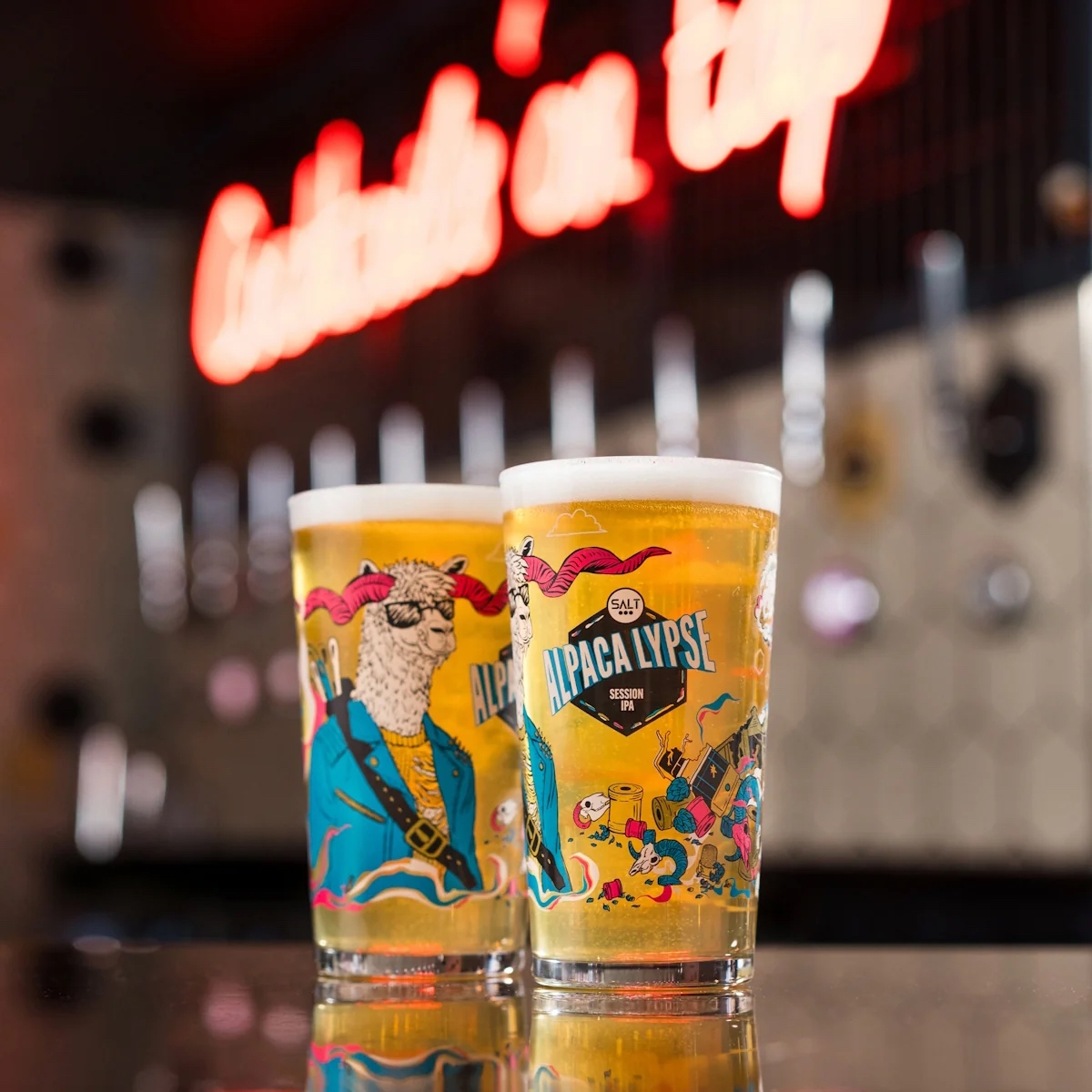
That unified focus has allowed Salt Beer Factory to rapidly expand its market presence. A prime example is Alpacalypse, a session IPA produced in partnership with distributor Molson Coors, which has seen explosive growth since launching in early 2025. For Simpson, Salt’s success stems from rejecting the exclusionary elitism that can sometimes permeate craft beer.
“Alpacalypse grew far quicker than we ever hoped it would. As a brand, Salt has always been about moving away from that ‘we’re a bit too cool for school’ sort of vibe and creating beers that are for everyone,” says Simpson. “When Jamie first set up Salt, his heart was always in pubs. He started as a landlord, and so when he set up Salt Beer Factory, it was about creating an American-style taproom environment where everyone gets to come, see where the beer is made, and enjoy it together as a community.”
While Salt captures the modern craft segment, Ossett’s traditional portfolio is experiencing its own dramatic renaissance, spearheaded by its flagship pale ale, White Rat. Originally brewed in 2013 at the Rat & Ratchet brewpub, the beer grew organically into Ossett’s leading brand. Over the past 18 months, Simpson and his team decided to double down on the brand’s potential, delivering an impressive 30% year-on-year growth for the 13-year-old recipe.

However, the team’s most radical innovation has been taking the White Rat recipe into a new format: White Rat Nitro.
“White Rat never ceases to surprise us,” says Simpson. “We trialed White Rat with some nitro injection on our keg line. We were doing it to trial a stout, but we thought, why not try it with White Rat?”
They tried it and collectively loved the results. For Simpson, the success of this beer in the off-trade has been particularly validating. “The Premium Bottled Ale (PBA) aisle in supermarkets has been in decline for quite a while, driven by a lack of innovation and progressiveness. Personally, I avoid the beers I love on cask when they are in PBAs because they don’t taste anything like cask. They are fizzy, thin, light, and lack mouthfeel.”
We are up 40% this year volume-wise, and the majority of that growth is driven by cask.
Edd Simpson, Ossett Brewery
To fix this off-trade issue, the brewery canned White Rat Nitro and presented it directly to supermarket buyers.
“We took it to some buyers in the supermarkets and handed them a pint, with the aim of them thinking they were drinking a pint of cask beer,” Simpson recalls. “It was only halfway through the pint that they said, ‘Right, when are we going to taste this White Rat Nitro then?’ And we said, ‘Well, you’re drinking it right now.’ It was an amazing experience. Because of that success, all of our off-trade cask beers are exclusively going to be nitro.”
Defying the cask narrative
In the production, marketing and sales of these beers Simpson says Jamie Lawson alongside head of sales Rich Nelson and head of production Matt Howgate alongside the valued team make all the difference. And on a brewing front, he acknowledges Howgate’s brewing prowess.
“To do most of your volume into the off-trade and make any money is not an easy thing to do, and you need to be brewing your beer efficiently,” Simpson stresses. “Matt is first class at that. You see lots of indie brewers struggling from a bottom-line perspective, and a lot of that comes down to how efficient you are with production.”

This operational discipline has allowed Ossett to be reverse the long-held cask narrative. Simpson insists that national statistics obscure what is actually happening among top-tier independent regional brewers.
“You see a lot of the national data around cask being quite a negative picture with cask in decline,” Simpson argues. “But I think it’s a really distorted picture because a lot of that data comes from the national pub companies, and independent brewers aren’t picked up properly on CGA reports. It’s not an accurate reflection of the indie sector. Ossett and our peers are all seeing real positive growth.”


